

Attackers now prefer to use existing security vulnerabilities because they can bypass traditional defenses through alternative entry points. The recent weeks demonstrated that attackers choose to use existing security vulnerabilities instead of seeking zero-day exploits because they can access systems through alternative entry points. The same basic security controls that organizations fail to enforce properly result in financial losses, time consumption, and damage to customer trust.
Let’s be blunt. The majority of security incidents result from basic security vulnerabilities, which do not require sophisticated nation-state-level attacks. The main causes of security incidents stem from unmonitored details, which include expired OAuth tokens, extended temporary permissions, untested system recovery processes, and unattended integration systems. The expenses from security breaches appear after the fact through extended work hours, consultant fees, and regulatory penalties, insurance complications, customer departures, and team delays from security incidents.
The following essential security measures require immediate implementation for practitioners who seek functional results beyond theoretical presentations.
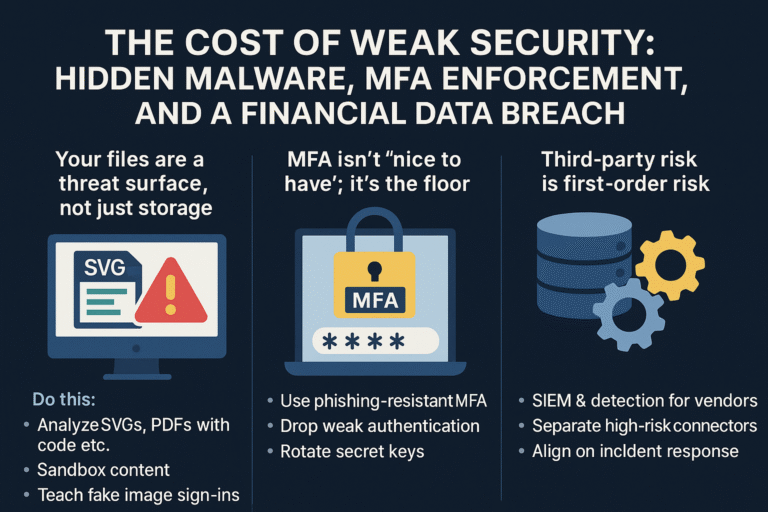
1) Your files are a threat surface, not just storage
The success of SVG-based phishing attacks stems from the fact that SVG files contain only text content. The combination of hidden redirects and link obfuscation enables attackers to bypass basic security checks, while content filters may also fail to detect the attack. Security programs that consider images as harmless data create an open door for attackers to exploit during future attacks.
Do this:
The security program should analyze SVG files and PDFs with JavaScript and office macros as executable code during both upload and access stages. The implementation of sandboxing technology should be mandatory for all high-risk transaction processes.
Business operations that do not require active content should have it disabled by default.
The system should notify users about security-related matters. A short 30-second training about image-based fake sign-in appearances delivers superior results than a lengthy 30-page policy document.
Data archiving best practices become essential at this point. The detection capabilities of your organization extend to include archived data that exists beyond its cold storage state. The process of artifact ingestion for long-term storage requires content disarm and reconstruction (CDR) followed by clean version storage. The practice of maintaining malware for future reference should be avoided.
2) MFA isn’t “nice to have”; it’s the floor
The Azure portal sign-in requirement for MFA from Microsoft represents a necessary and beneficial change. Your organization requires MFA enforcement from vendors when your internal identity security standards need improvement. The combination of credential stuffing, phishing kits, and token theft operates as an industrialized threat. They’re industrialized.
Do this:
The implementation of phishing-resistant MFA through FIDO2 and passkeys should become the standard authentication method for administrators before expanding to all users. The security of OTP text messages is superior to no authentication, but organizations should implement better alternatives.
The security team should eliminate all authentication methods that enable users to bypass contemporary authentication protocols. Any system that fails to support modern authentication protocols should avoid accessing your most valuable assets.
Third-party applications should receive secret key rotations, and their token expiration periods should be reduced, especially for third-party applications. The extended lifetime of OAuth tokens enables attackers to maintain persistent access to your system.
The MFA guidance from CISA serves as an excellent resource for stakeholders who need a brief explanation or a shareable document because it provides vendor-neutral, practical advice.
3) Third-party risk is first-order risk
Financial services organizations should expect vendor-related breaches because they represent the standard occurrence in the industry. The lengthy dependency chain creates limited visibility for your organization while attackers understand these vulnerabilities. Your supplier cannot receive security patches, but you can establish boundaries to limit their attack capabilities.
Do this:
The assessment of integrations should take precedence over vendor inventory management. Any application that enables data reading or export operations for customer information should receive monitoring from SIEM systems and receive anomaly detection and kill switch functionality.
High-risk connectors need their own dedicated, separate tenants or service principal segments for security purposes. A single token should not have access to all environments in your system.
Suppliers need to receive advance agreements about incident response procedures from your organization. The incident response process requires the identification of responsible parties and their response timeframes, and complete access to relevant system logs. The delay in starting this conversation during a security incident will result in negative consequences.
Secure data archiving proves its value through its ability to handle these situations. Your ability to prove data ownership and reconstruct events and restore verified data quickly determines whether you will experience a minor setback or a major financial loss during the remediation process.
In the end, strong security comes down to getting the fundamentals right and making them part of daily operations. From enforcing MFA to reducing third-party risks and applying data archiving best practices, the difference lies in consistent execution. At Spictera, we help organizations strengthen these basics with solutions that make security and archiving practical, reliable, and easier to manage—so teams can focus on growth with confidence.